
I scrolled through her website, amazed at how many she had done.
She was a clear competitor, but she was, in the words of Simon Sinek, a Worthy Rival.
She had more than 50 books listed on her website, and I wasn’t clear how she had done so many.
I had to learn.
Since we had started this ghost writing business in August 2023, when our first ever client for ghost writing approached us, we hadn’t known who to look for. With good reason.
Ghost writers usually don’t reveal themselves. That’s why they are called ghosts. Because they go behind the scenes, writing furiously, and the person they are writing for eventually has their name on the book.
Boss of Me – For those who want someone with many books under their belt, at about 15k for a full book (without printing)
Take it from me. If you want an experienced team, you might want to go with Pearlin Siow and her team at Boss of Me.

Her team has written so many books that it’s hard to imagine another safer pair of hands in the industry.
What’s more, she also gives you full rights over the book. She does not insist that her name be on the book, unlike the other juggernaut in the field – The Nutgraf.
The Nutgraf – not real ghosts, but they will write you a good book
The Nutgraf will insist that their authors write the book, and that the book has the author’s name on it. They do this to ensure the quality of the book, and to make sure that the book has credibility.
How do I know?
Well, I asked.
In February 2024, I was facing serious difficulty with the work I was doing ghostwriting the book of the CEO who had engaged me. I was lost. I didn’t know how to piece together a coherent structure. The story read like a jumpy journey you would have on a pothole laden road.
I called Karen, the account manager at Nutgraf and asked if they would be willing to do consultations with me, serving as an editor on the script.
They said no.
I wrote in, and asked again, and they said no thank you, we prefer to be the authors in charge of the work. They didn’t say this, but I guessed it was because this would allow them to control the quality of the work.

You might be an A-lister in your niche. Heck, you may even have created the industry. But The Nutgraf will tend to insist that their author’s name is on the book, instead of yours.
There’s an important technical reason for this.
Gonzo journalism allows for the journalist to share their perspective
In ‘Behind the Banyan’, Aaron Low writes about Ho Kwon Ping (or KP, as he’s affectionately known), the founder of the Banyan Group. KP pointed out that Aaron first raised this term ‘gonzo journalism’ to illustrate how the writer would be using his own personal experiences to see the story of the subject.
In this case, Aaron would be using his personal experience cofounding The Nutgraf, to learn about KP’s own experiences founding a global business.
This is much easier than a ghostwriter, which will have to see things from the subject’s point of view.
This can be tricky, as there are times when it will look self-aggrandising and boastful. For example, how do you write about your achievements whilst sounding modest about them?
As ghostwriters, we recently faced this conundrum when we wrote the memoir of a CEO. We wanted to highlight his achievements but writing something like:
That year, I gained 45% increase in profits,
can sound arrogant.
A better way? Use a third party to write, and recount what happened.
The journalistic style brings nuggets of wisdom
Why The Nutgraf are so good at their book writing craft is partly because of their backgrounds as journalists. The Nutgraf was founded by 3 ex-journalists, who came together to form a content agency.
From my own experience freelance writing advertorials for Singapore Press Holdings (SPH) I do know that the experience is tough and teaches you intensely about how to be a better writer.
I remember the first assignment when I had to interview 11 organisations for the inaugural Workplace Safety Health CARE Awards. That time, I went from Tuas to town, interviewing HR personnel about what they did to make their offices great for the mental health for employees.

But even after writing the first draft, the editor had the sharp wit to cut through the fluff and come to the heart of the story. She kept probing me, asking,
what’s the core idea of this article?
What’s the big, life transforming idea that will make people read it?
That was hard to answer.
Imagine if you were trained as a journalist at SPH, and you had to keep pushing to get such good articles out.
You would definitely improve as a writer.
That’s why The Nutgraf have been so good at finding nuggets of stories.
For example, in their recent celebration of NTUC’s anniversary, they released The Price of Being Fair, the authorised biography of NTUC.
In that book, they shared nuggets of wisdom. Like how the NTUC staff would covertly shop at Sheng Siong, their competitor. They would compare the price of eggs, rice, and milk to see if their prices were competitive.
Finding those nuggets are harder than you’d think. How do you even ask the questions that will prompt that level of detail? You would need to have had a lot of experiences interviewing people, for that to even happen.

The reputational care
But perhaps the most important part is realising the amount of care they will give to your personal brand and reputation. Having written for big personalities like former Prime Minister Goh Chok Tong, and business stalwarts like City Developments Chairman Kwek Leng Beng, they will take great care to present your strengths (and mistakes) in the best light.
For example, in the City Developments story, I found it amazing that Nutgraf was able to present the $1.92 billion in losses in Sincere Properties with such care and nuance.
Rather than throwing CEO Sherman Kwek under the bus, blaming him for the huge loss, they recognised that it was a business mistake, and wrote about how they chose to move on from the loss.
Well I hope you’re not having to present a $1.92 billion loss to your potential readers.
But if you’re a big personality, you can trust them with your personal brand.
Then, there’s us.
Gutenhag, the ghostwriters who have craft
We’re the newest kid on the block.
But that’s not to say that we aren’t good.
In fact, I may be biased, but I do think that we are ghostwriters who treat this as a serious craft.
Take one of our recent discussions recently. My editor and I had been puzzling over how best to structure the book, given that there were still glaring plot gaps in the middle of the book. We were lacking information, and we didn’t know where to get it. Our interviews had turned up little.
Build, and rebuild good structures
We were desperate.
Not knowing what else to do, my editor suggested a bootcamp to work on the book. I agreed, and pulled him (unwillingly) to Johor Bahru, to do it.

I believed that we had to get away to have some headspace for the book. But he probably didn’t think it needed that. But sitting over Danga Bay, we:
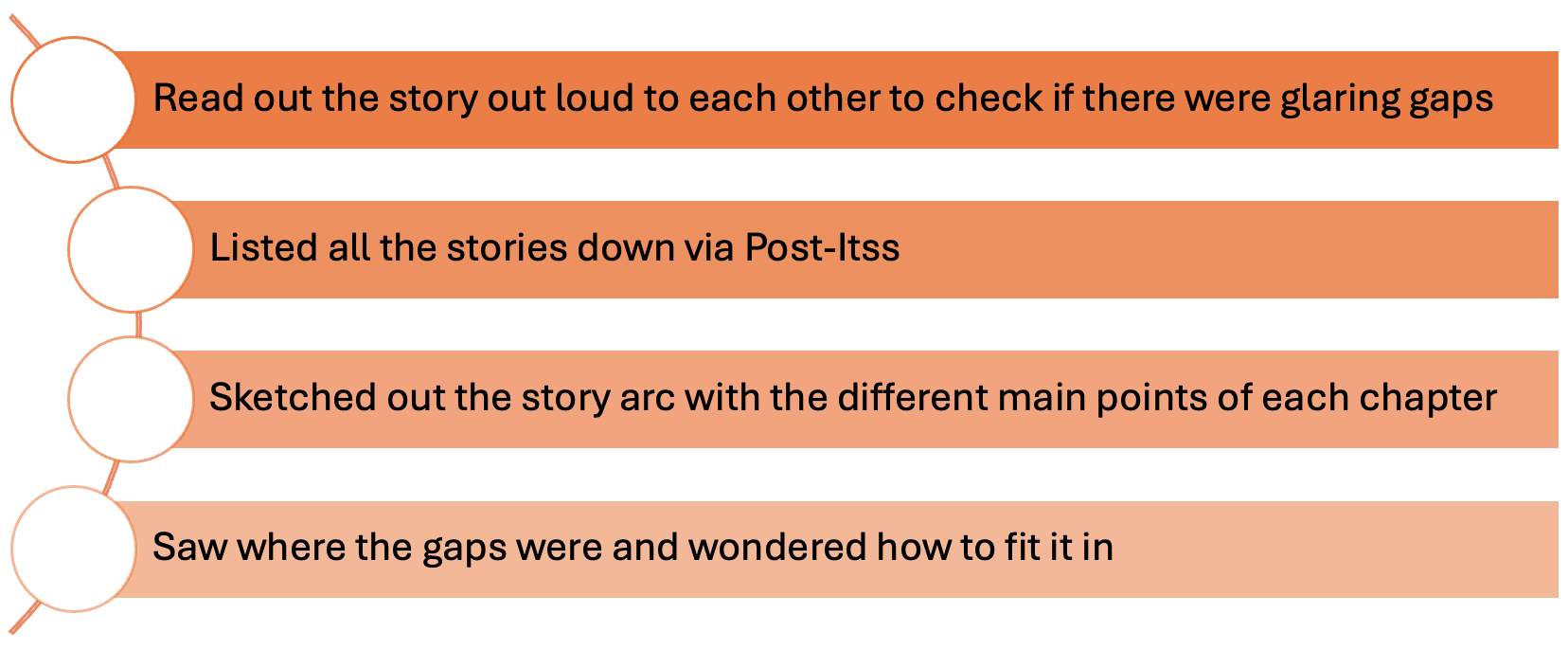
If you look at this example, it highlights one thing.
The importance of structure. If you don’t have a good structure, you’re always going to be stuck. No matter how many stories you find, you will end up feeling like you’re building on a house of cards. It won’t stand easily. Your book may end up reading like an incoherent lump of stories put together.
Experts at finding stories and structuring them
But that begs the question. Is there a better way to structure this?
Over the years doing 4 books, we’ve come to see this.
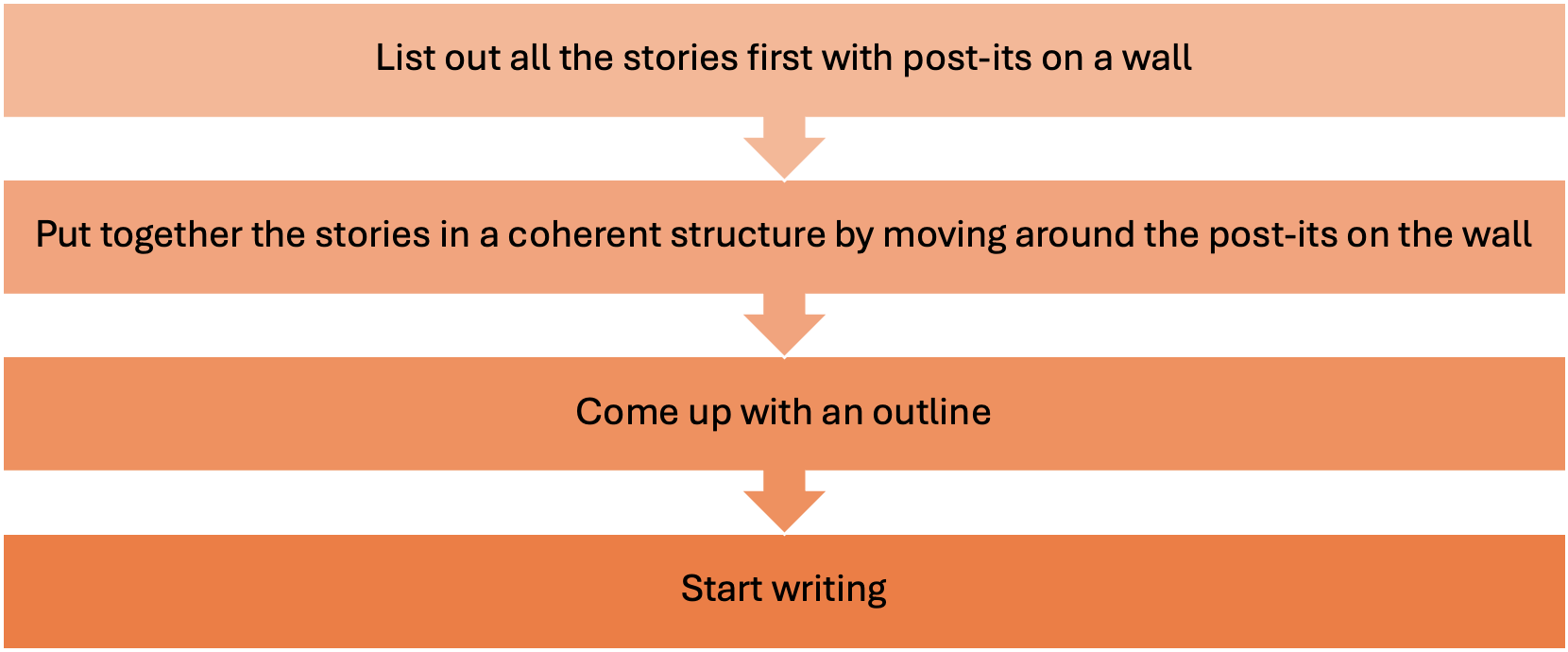
It’s only after you come up with the outline, that you start writing.
If you entrust a ghostwriter, you might wonder how the ghost is going to know all your stories. This is where you, the author, is going to need to engage with the ghostwriter regularly. There’s no way other than having interviews on a fortnightly basis.
The ghostwriter would
- Send you questions beforehand
- Interview you
- Observe your interactions with key partners and stakeholders
Low Shi Ping for her experience with architecture, design, and business
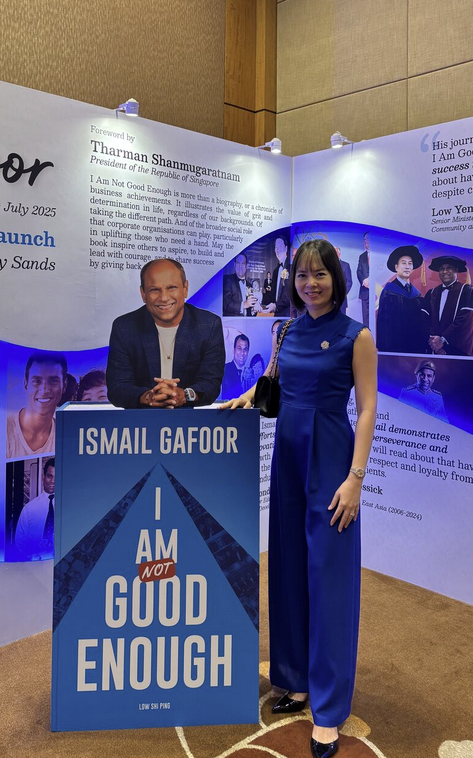
Someone who has a keen eye for observing, and knowing how best to interact with big personalities is Shi Ping, who worked her way up in niche luxury, magazines. She most recently ghostwrote for PropNex’s cofounder, Ismail Gafoor. Seeing how she worked that entire book from start to end, tidily tying together the whole narrative, is hard, but vital.
When we met her, I knew immediately that I was talking to a pro. She knew all about developmental editing, structuring, leading the client, and how to identify the right clients for the business.
She was mostly definitely a pro.
Getting someone to write your book is about trust
I will share a final story.
I recently asked the CEO why he picked us, even when there were so many other more people with experiences, and we were 27 year olds with little experience.
He shared that when he called Pearlin, he could see that she had a lot of experience. But at the end of the day, when he first called me, he felt a different form of resonance.
When you find a ghostwriter, that person is going to follow you for about a year. You’re going to meet him so often. If you don’t like them, it will be a long ride.
Find someone you trust, and more importantly, like. That will be the dealmaker.