
I sat in the budget bread shop in Kyoto, listening to the writer share about the progress of his interviews. He said he’d done more than 20 interviews, but he wasn’t too sure how much he could use because some of it was confidential information.
Then he threw in the kicker.
The management hasn’t approved what should go into the book.
Mentally, I did a facepalm.
They wanted this commemorative book by mid 2025, and it was already December 2024.
How was this possible?
If you’re looking to do a commemorative book, and you’re picking a writer or heck, even an agency to do it, here’s what you should not be looking out for.
Lots of agencies are going to tell you they can do it. Then they show you the annual reports they have done, or even the research reports they have designed. And you think,
hey, maybe there’s something here?
No, there’s nothing there.
Over the past 5 years of writing and producing books for ourselves, and other agencies, we’ve come to realise that a book is not like any other content piece.
A book is not any other content
If you’re doing a commemorative book, you want to celebrate the many years of achievements you’ve come through.
That will require a certain measure of gravitas.
And for that gravitas to come through, you need an agency that knows how to … wait for it, because it might not be something you expect.
The skill you’re looking for is structuring.
To structure many different pieces of content.
If you want to pay for a long track record, go to Nutgraf
Sure, we get it. You want to save money. But just look at what Nutgraf charged.
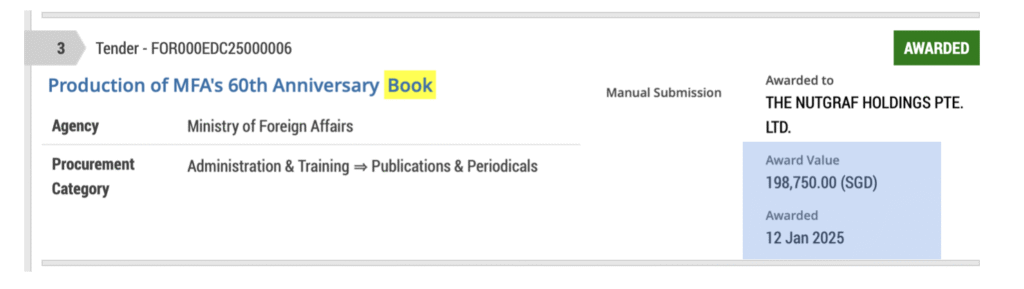
Just look at what Nutgraf charged MFA.
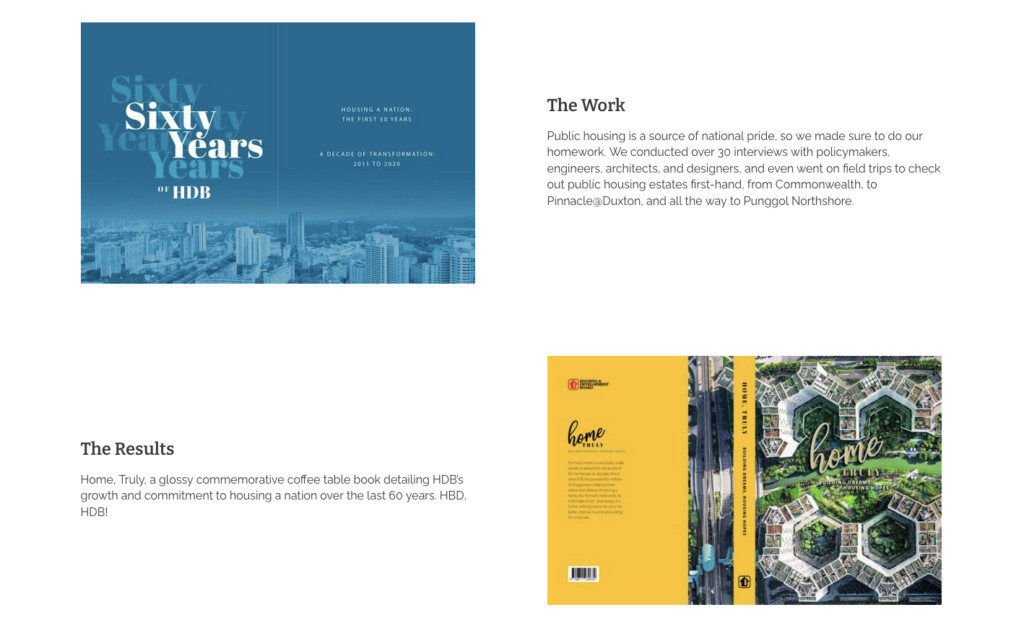
Just for creating the book. We like to think of Nutgraf as the guiding light that inspires us to do better. Over the years, they have written a few commemorative books, such as the HDB story. You know they will deliver the goods, especially with a team of ex-journalists that are experienced with finding nooks and crannies of stories, and writing it in an engaging way.
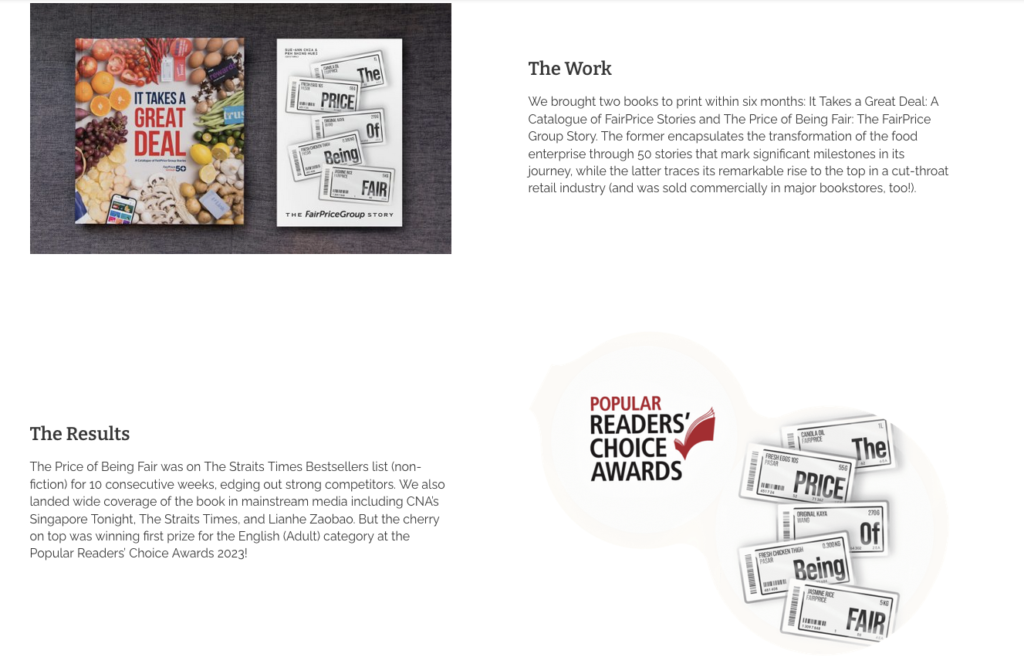
During the time when few would think of writing the stories of Singapore’s local businesses, Nutgraf’s founder Peh Shing Huei also bet big on the stories of local stalwarts like FairPrice. In FairPrice, he wrote about how it was sad that many of our local businesses had become shining lights, but there were few book-length treatises about how they succeeded. So it’s vital that stories like these are made.
But of course, they cost a lot. The best cost, and if you don’t want something that looks cheap, you might want to pay up.
What are you paying for?
You’re essentially paying for someone to write your company’s story, so that more will invest in it.
That’s worth hundreds of thousands. Because with a clear and coherent narrative, the average man on the street buys into it.
Invests more, buys more of your services.
And you make more money.
So how do you know the agency you’re choosing is worth their salt?
If you want value for money and quality, you can look at us, in Gutenhag.
Of course, you might want a cheaper option. We won’t charge you a 6-figure sum, because we believe that the work of immortalising your company’s stories through books and content, should be accessible.
Yes, there’s the fact that we’re both young, single, and don’t have as many dependents. And because we don’t have a staff team as large as 20, we don’t have to pay for fancy overheads like a HR and a swanky office. Instead, what we do is to take a small number of projects, and do our best with them.
Look at ASTAR’s GUSTO, for example. They had done the great work of following parents and their children for 15 years, and now wanted to make their research more accessible. Copyediting and reworking some of their structure, we built a beautiful book for parents and their teenagers to enjoy, and to take away useful information that they could use.

Look for an agency’s ability to structure data
Huh? Why does that even matter?
For your history to shine through, your agency will need to read into your history, understand your work, and put it together in a coherent narrative.
For example, in a commemorative book we pitched for Boustead’s 200th Anniversary, we had to dig into their archives, annual reports, and decide how best to shape their story.

As you can see here, a good bookwriting agency would come up with the concept based off what they see in your materials. They then build the core ideas.
But beyond the basic ability to concept and ideate, the more important part is for the agency to be able to project manage.
If you read the foreword of many authors, they start by telling you how difficult it was. George Yeo, the previous Foreign Minister of Singapore, wrote about how he initially thought the book might take a few months.
But he eventually took 3 years to finish it.
That’s why you need an agency that’s great at managing large projects like a book.
Pick Candid Creation for the many things you have to keep track, and their track record in project management
Books are large projects. And they die not because of poor writing, but because of poor energy management. A book is an intense sprint, and many people rightly say that they wouldn’t write a book again after their first time writing one.
And that’s because keeping the momentum of writing everyday, of pushing out the chapters bit by bit, following the outlines, can be really tough. One of the toughest books we did was the the memoir of a CEO. From the time it started in July 2022, it took us till April 2026 before we finally had the book out.
Following to his conference in Bangkok, sitting in his Porsche, and sitting in monthly interviews with him helped us to see the enormity of the task of writing a book.
It’s not just the writing that matters.
Actually, there are countless other matters you need to pay attention to.

Each of the processes we’ve listed above doesn’t come about by chance. There are countless moving pieces involved.
For example, as an agency, we initially thought that it was just about writing a book.
And one of the best in the business is Kok Hwa, of Candid Creation. I did my first ever book with him and was blown away by how he structured the whole process. From giving us the analogy of scaling Everest, he laid out the key times we had to hit.
And that served as a great base to know what we had to do, by when.

Even when there were times I wanted to give up because of poor feedback from a mentor I respected, he told me
John, there won’t always be people who love your book. You just have to get it out there.
But beyond just doing the book, you’d quickly realise that you also need to get institutional support for the book.
Building institutional support
For this book, we had to interview key members of their management team and get them to talk about sensitive issues, such as:
- Was the leader actually good?
- How were they earning more (or less) money under the CEO’s leadership?
- What were the CEO’s flaws?
None of these are easy questions, but with an agency who’s skilled at asking questions, you will find yourself being able to find a way into such sensitive questions.
Besides, you’re not just asking for them to think about the leader, but you’re asking for an invaluable resource they can never replace – time.
Agencies who can build that institutional support for your book is vital, because they are going to be spending time finding pictures, resources, and time for you to interview them. Your agency will need to be able to explain the purpose of the book in a way that makes sense.
After all, why would they want to spend the time they can spend on working with you?
And beyond that, during procedural, boring tasks like applying for the ISBN, getting the authors’ year of birth, all take time.
This requires skill. One of those is ChinKar from Write Editions, who’s been doing this for the last 20 years. He has built big-time books such as hospital books on COVID, which would involve multiple layers of approvals.
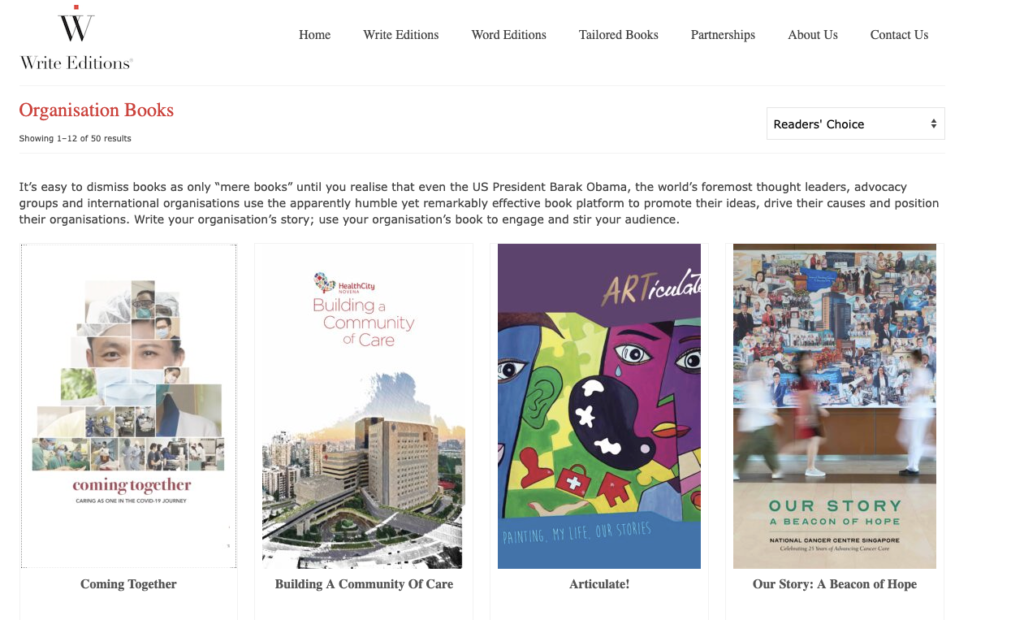
I also worked with ChinKar on my second book, which he brought to life, with some financial support from him too. I will ever be indebted to him for teaching me the trade.

Bringing a book from start to end is about discipline
After 5 years of writing, I’ve come to see that those who do manage to ship books, are those who have discipline.
A wicked amount of it.
How do you find that in the custom publishing agency you choose?
See what they have done in the past, and ask questions like:
- How long did you take for this book?
- Why did it take this long?
And if you find the agency that can ship on time, on target, that’s the one you should keep choosing.